
How GEO insights can improve paid advertising
Turn customer questions, competitor positioning, cited evidence, and visibility gaps into paid-ad hypotheses, stronger landing pages, and measurable experiments.
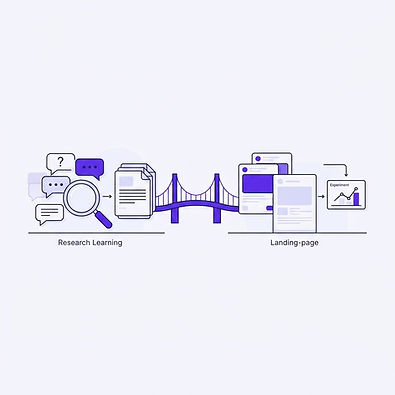
The connection: insight, hypothesis, experiment
Generative engine optimization (GEO) helps you understand how AI answers describe your category, which questions lead to recommendations, which brands are mentioned, and what evidence the answers cite. Those observations can inform paid advertising even when the advertising runs outside an AI assistant.
The bridge is not “improve GEO and ads automatically perform better.” It is “use observed customer needs and competitive context to propose a better message or destination, then test it with paid-campaign data.” The workflow below is GeckoCheck’s practical interpretation, not a provider-endorsed targeting formula.
For the product overview of visibility monitoring, competitor benchmarking, and source tracking, see GeckoCheck Intelligence. This is a public product overview, not the signed-in report.
1. Turn customer questions into campaign themes
Group comparable discovery, comparison, and purchase-evaluation prompts by the decision the customer is making. Pay attention to constraints such as price, compatibility, size, delivery, or suitability. Keep branded and unbranded questions separate.
Translate these themes into candidate ad groups, search keyword research, creative briefs, or contextual messaging hypotheses where the chosen platform supports them. Validate demand and eligibility in that advertising platform: a tracked GEO prompt is neither measured search volume nor a targeting option you can necessarily purchase.
- GEO learning: buyers repeatedly ask about portability and airline dimensions.
- Paid-ad hypothesis: a specific, verified portability message may be more useful than a generic premium-quality slogan.
- Validation: check campaign feasibility, available demand signals, and product evidence before committing budget.
2. Use competitor positioning to test differentiation
Read why competitors appear in independent answers, not just how often they appear. Record the benefits, objections, comparisons, and supporting sources associated with them. Then compare this organic context with competitor advertising observations where available.
Identify a customer need your product genuinely serves but your current message does not explain. Create distinct messages to test rather than copying competitor claims. An organic mention or a repeatedly observed ad does not prove that a competitor’s campaign converts well.
- Separate direct observations from interpretations of why an answer preferred a competitor.
- Verify every proposed product claim against current evidence.
- Keep competitor organic presence, sponsored appearances, and private campaign performance distinct.
3. Use cited evidence and objections to strengthen landing pages
Inspect what the cited pages actually establish. A citation may reveal the facts needed for a decision, such as dimensions, integration requirements, return conditions, or documented limitations. Check the original source before treating the answer’s wording as reliable.
Bring the relevant facts onto your own landing page, with inspectable evidence and clear qualifications. Match the destination to the ad’s promise and the user’s intended next step. Google’s landing-page guidance explicitly recommends alignment between the ad, keywords, and destination; it does not say that a GEO citation is an advertising ranking signal.
Resolve unsupported claims, outdated facts, confusing comparisons, and missing conditions before sending paid traffic. A page can be clearer for both AI discovery and human buyers, but those improvements have separate outcomes and should be measured separately.
4. Use visibility gaps to prioritize investigations
Look at gaps by customer intent, model, market, language, and journey stage. A relevant segment with weak organic visibility may merit a paid test while the content team addresses the underlying information gap. A strong organic segment may also merit a paid test if the commercial opportunity is credible.
Do not automatically allocate more budget to the weakest GEO score. Check market demand, product availability, commercial value, campaign eligibility, and historical paid performance. A low visibility result can reflect sampling limits rather than an underserved advertising audience.
Use sentiment findings as prompts to investigate recurring objections and improve accurate messaging, not as access to private user sentiment or a ready-made targeting audience. A question observed in a GEO cohort is not a list of people you can retarget.
5. Write a GEO-to-paid experiment brief
- Observation: the question, independent answer, source evidence, platform, market, language, and review period.
- Commercial fit: the product, decision stage, verified benefit, and reason the opportunity matters.
- Hypothesis: the specific message or landing-page change expected to help the intended audience.
- Execution: the advertising platform, supported campaign approach, owner, approved budget, and policy checks.
- Measurement: the primary business outcome, guardrail metrics, comparison method, review window, and decision rule set before launch.
- Limitations: unknown demand, missing observations, sample changes, and assumptions requiring validation.
Worked example: a carry-on campaign
Illustrative scenario, not a real GeckoCheck finding: matched comparison prompts repeatedly ask about carry-on weight and airline dimensions. Competitor answers emphasize portability, while your landing page relies on an unsupported “perfect for every airline” claim.
First verify the actual weight, dimensions, and relevant airline restrictions. Replace the universal claim with accurate product facts and clear limits. Then propose an ad-message test comparing a verified portability benefit with the existing general brand message. Ensure both ad destinations fulfill their respective promises.
If you change both copy and the landing page, either separate the experiments or describe the result as a test of the combined package. Do not attribute the outcome to the headline alone.
Source: GeckoCheck educational scenario. Period: fictional planning period. Sample: hypothetical prompts, messaging, and landing-page issues. Limitation: no measured campaign results, conversion lift, spend, or platform-wide demand.
6. Evaluate the paid test separately from GEO movement
Use the advertising platform and business analytics you actually have to evaluate campaign results. Choose the primary outcome appropriate to your objective, such as qualified leads, purchases, or cost per qualified acquisition. Click-through rate can diagnose interest, but it does not establish customer value.
Where feasible, use an appropriate controlled experiment or holdout. Otherwise disclose that the comparison is observational and record changes in audience, bids, seasonality, offers, and tracking. Do not declare a winner from a short run with too few outcomes.
Continue monitoring organic mentions and citations with a stable GEO cohort, but do not claim that an improvement in paid performance caused an organic gain, or vice versa. GeckoCheck observations alone do not provide revenue attribution or a competitor’s return on ad spend.
What changes for ChatGPT and Google AI Overview ads?
For ChatGPT ads, GEO questions and evidence can inform messaging hypotheses, but OpenAI states that ads are separate from and do not influence its answers. Do not present a paid campaign as a way to buy an organic ChatGPT recommendation.
For Google AI Overview ads, use current Google Ads eligibility guidance. The cited documentation says advertisers cannot directly target only placements within AI Overviews and do not receive a separate AI Overview placement-reporting segment. A GEO visibility gap therefore cannot simply be turned into an AI Overview-only campaign or conversion report.
For other paid surfaces, apply only the campaign controls that platform supports. GEO insights are planning inputs, not proof of access to private conversations, a disclosed ranking formula, or guaranteed placement.
A useful shared workflow for content and paid teams
Keep one brief linking the observed need, verified evidence, content improvement, paid hypothesis, owner, and review date. The teams can share the learning while keeping organic and paid outcomes distinct.
Review what the paid test establishes, update messaging where the evidence supports it, and check whether the improved content accurately answers the original customer questions. Keep unsuccessful tests and contradictory findings in the learning record instead of reporting only wins.
Sources and review
Reviewed . Provider availability and formats can change; check the linked documentation for current details.
Related guides
- Find high-intent AI advertising opportunities
Use ad triggers and competitor evidence to identify buying questions, prioritize visibility gaps, and create an actionable opportunity brief.
- How to analyze competitors’ AI ads
Compare competitor messages, offers, prompt context, and placement evidence, then turn recurring patterns into a focused response.
- Measure AI advertising without confusing visibility and revenue
Keep observed paid placements, organic mentions, visits, and conversions separate, and make fair comparisons with explicit sample limits.
- How AI ads relate to organic brand visibility
Distinguish sponsored exposure from organic mentions and citations, and investigate potential attention shifts without making unsupported causal claims.
Still stuck? Contact support ›